Fall Gutters and Downspouts in Louisville
Leaves are coming. Are your gutters ready? In Louisville that question has a specific answer, because the tree canopy here is not an accent. It is the defining feature of whole neighborhoods. The maples and sycamores through the Highlands, the mature hardwoods in Crescent Hill and Clifton, the oaks in St. Matthews and Audubon Park. Those canopies are the reason people love these streets, and they are also the reason a Louisville roof collects a serious volume of debris every October and November.
Big leaves, long runs, old houses
Louisville has a particular combination that makes gutter season harder than average.
The leaves are large. Sycamore and maple leaves are broad and heavy, and when they get wet they lie flat and form a seal rather than breaking apart. A mat of wet maple leaves across a gutter trough does not let water through it.
A lot of the housing stock is older, which means longer gutter runs on taller homes, more interior corners and miters where debris catches, and downspouts that make more turns before they reach the ground. Every turn is a place for a clog to form.
And the material compacts. Underneath the leaves is a season of seed pods, helicopter seeds, small twigs and shingle grit that settles into the bottom of the trough and turns into a dense sludge. That layer holds moisture against the metal all year and is the foundation every new clog builds on.
The downspout is where it actually fails
Most homeowners inspect the wrong thing. Debris migrates toward the outlet and jams at the first elbow, which is the narrowest point in the system. From the ground the trough looks clear, because it is. The water still has nowhere to go, and the first heavy Ohio Valley rain comes over the front edge in a sheet.
Why overflow is worse here than it looks
Louisville gets real freeze and thaw cycles. That changes the math on standing water.
A gutter holding wet debris in December is a gutter holding ice in January. Ice adds weight to a system hanging off a fascia board, and it backs water up at the roof edge where the roof was designed to shed water, not hold it. Every freeze and thaw cycle works that water deeper into whatever it is sitting against.
On the ground, overflow dumps several hundred gallons of roof water directly against the foundation, over and over through the season. Louisville has a lot of basements, and saturated soil at the base of a wall is how water finds its way into one. Freeze and thaw then works on the same saturated ground all winter.
What a professional clearing includes
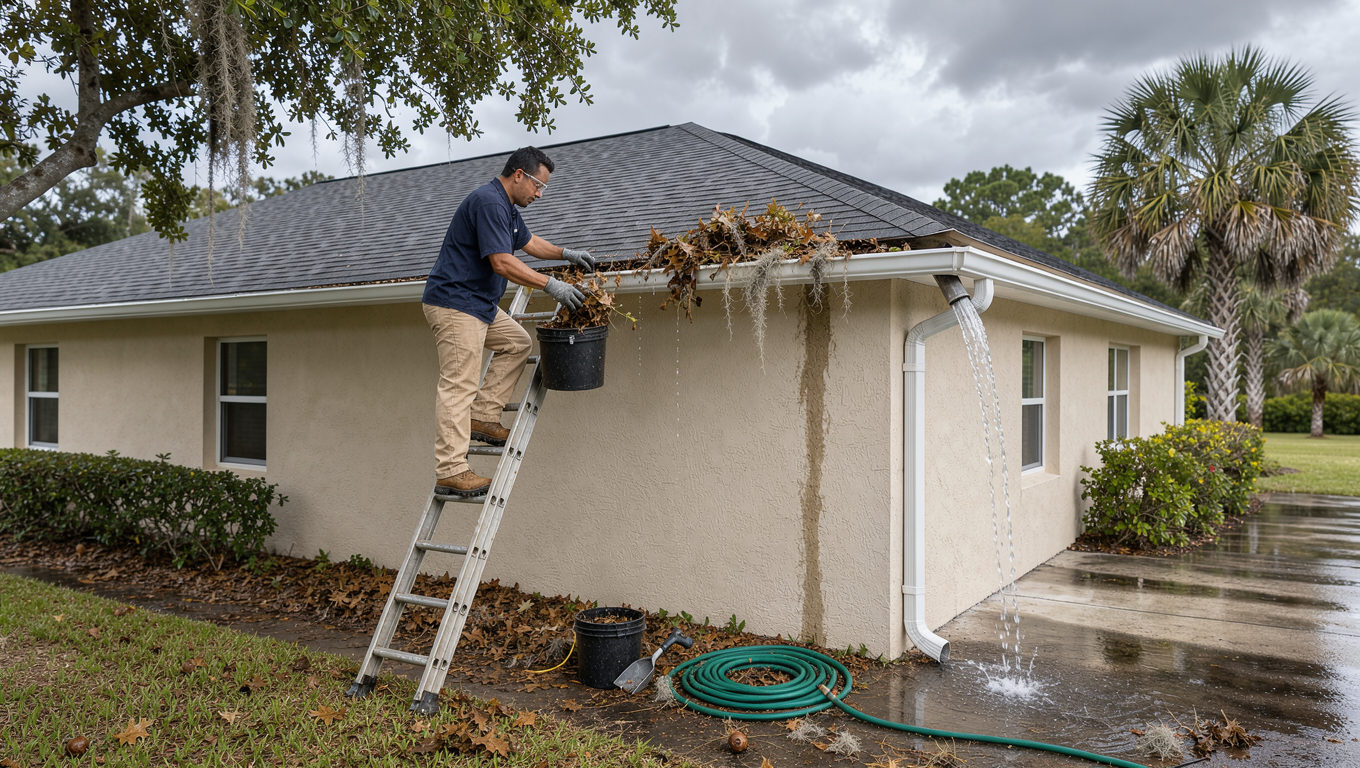
· Full debris removal, including the compacted layer at the bottom of the trough rather than just the loose leaves on top.
· Downspout flow testing at every outlet, confirmed at the discharge point. This is the step that catches the jammed elbow a visual inspection misses.
· Discharge direction, so water leaves the house rather than pooling at a corner or running back toward a basement wall.
· Hanger and pitch check, because wet leaves are heavy and sagging sections hold the standing water where the next clog starts.
Why it is seasonal and not one time
Louisville drops leaves every fall and seeds every spring. A house cleared in April is loaded again by November. There is no permanent version of this job, only a current one.
That is the logic behind HomeSmiles 365: the drainage system gets looked at quarterly, the downspouts get tested every visit, and the condition gets written down so the question of when it was last done has an answer.
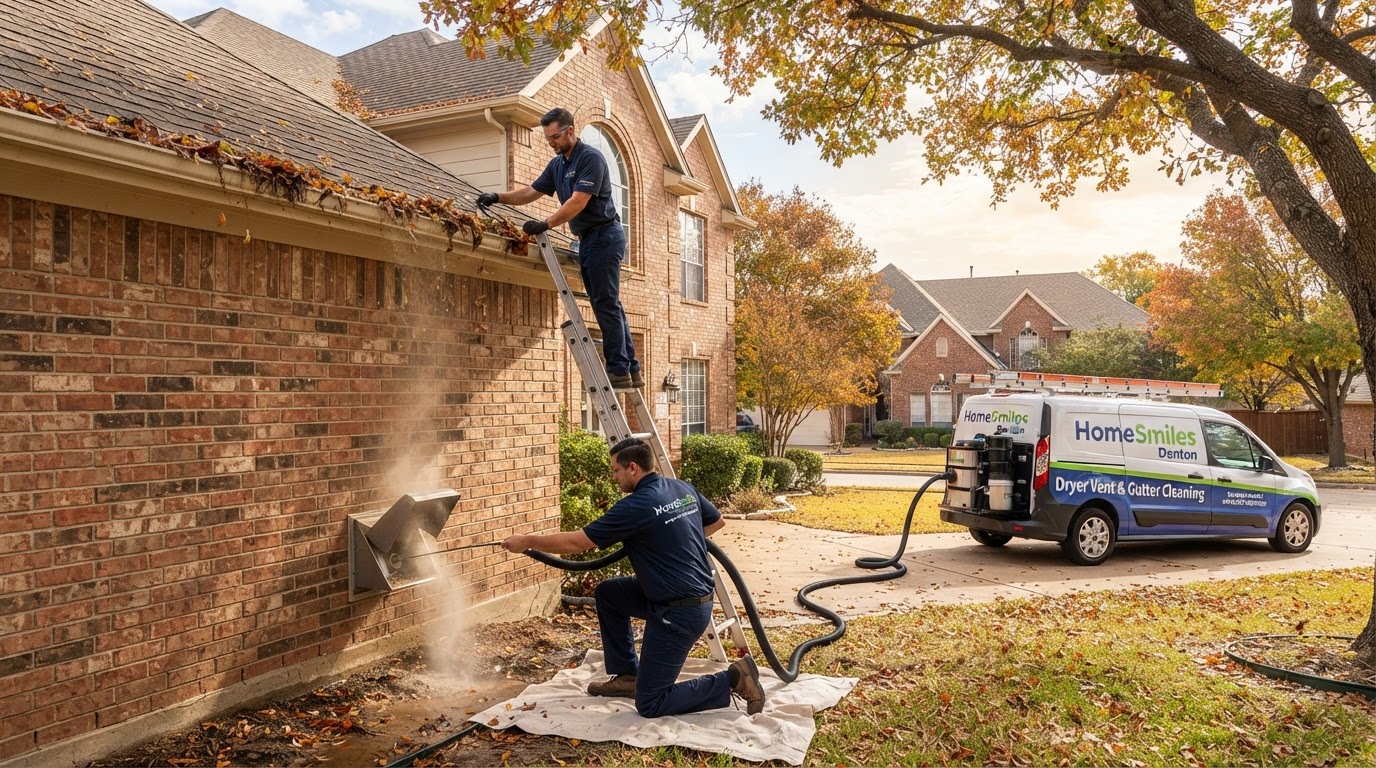
Your weekends are for pumpkin patches, football and family. HomeSmiles Louisville clears the leaves and debris so your gutters carry rainwater where it belongs. Keep your feet on the ground and your weekend open.
Book your gutter cleaning.