Fall Gutters and Downspouts in Miami
South Florida weather works on your exterior all year. That is why fall drainage in Miami has nothing to do with leaf drop and everything to do with volume. There is no single week when the trees come down and the gutters fill. Instead there is a year round shed of palm litter, sea grape leaves, ficus debris and bloom material, plus whatever the last round of storms moved onto the roof.
So the question here is not whether the gutters filled up this month. It is how long they have been filling.
What actually blocks a Miami gutter
The debris profile is different from the rest of the country, and it is harder on a drainage system.
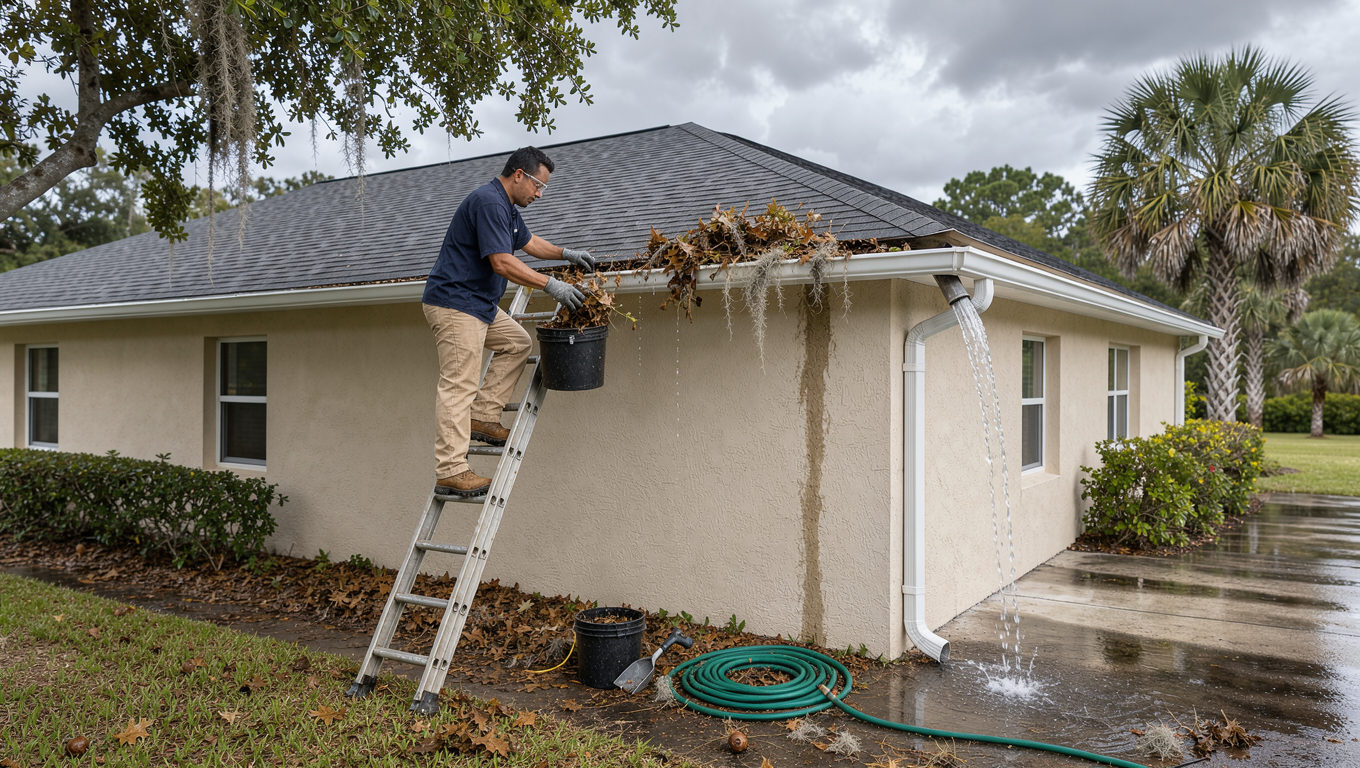
Palm material is fibrous. Fronds, seed pods and the stringy matter that comes off a palm do not break down and wash through. They tangle, and tangled fibrous debris forms a plug that water cannot pass, usually right at the downspout outlet.
Broadleaf tropical debris is thick and waxy. Sea grape and ficus leaves are heavy, they lie flat and they seal a trough rather than letting water filter past.
And because it is always warm and usually humid, organic material in a gutter trough does not dry out and turn brittle the way it does up north. It stays wet, and wet debris compacts into a dense layer that will not move on its own in any amount of rain.
Add the salt and grit that coastal air deposits on everything, and the bottom of a Miami gutter carries a layer that holds moisture against the metal twelve months a year.
Why afternoon storms are the real test
Miami rain arrives all at once. An afternoon storm can drop more water in twenty minutes than some regions see in a week, and a drainage system either moves that volume or it does not. There is no gradual version here that gives a homeowner a warning.
When it does not move, the water comes over the front edge in a sheet and lands right at the base of the house. In a region with a high water table, saturating the ground next to the foundation repeatedly is not something to shrug at. Overflow also drives water behind fascia and into soffits, and in this humidity, water in a soffit is the beginning of a much larger exterior problem.
The exterior is part of the same job
This is where Miami differs from a northern market. Clearing a gutter here without looking at the exterior misses the point, because the same conditions that load the trough are also working on the walls.
Constant humidity keeps the shaded walls biologically active year round. Salt air leaves a film on everything within a few miles of the water. Overflow running down a wall feeds both. The drainage and the exterior are one system, and the most useful visit handles them together.
What a professional clearing covers
· Full debris removal, including the wet compacted layer at the bottom of the trough rather than the loose material on top.
· Downspout flow testing at every outlet, confirmed at the discharge point, which is where fibrous palm debris jams.
· Discharge direction, so storm volume is carried away from the house rather than released against the slab.
· Hanger and pitch check, because wet tropical debris is heavy and a sagging run holds standing water.
Why it is a schedule and not a one time job
Nothing here is seasonal in the northern sense. The shed is continuous, which means a gutter in Miami is always loading. A system cleared in June is loaded by October.
That is the argument for HomeSmiles 365: quarterly attention, downspouts tested every visit, exterior handled alongside it, and the condition written down.
Your weekends are for pumpkin patches, football and family. HomeSmiles Miami clears the leaves and debris so your gutters carry rainwater where it belongs. Keep your feet on the ground and your weekend open.
Book your gutter cleaning.