Fall Gutters and Downspouts in Savannah GA
Coastal weather leaves a mark. In Savannah it leaves several, and the drainage system on a house is where most of them end up collecting.
Fall here is not a leaf drop event the way it is inland. It is the point in the year when a season of heat, humidity, salt air and heavy rain has finished working on the roof, and the gutters are holding the evidence.
What a Savannah roof delivers into a gutter
Three kinds of debris, and all of them behave badly in a trough.
Live oak leaves. Small, leathery and shed on their own schedule rather than all at once, which means a steady supply year round with heavier stretches in late winter and spring. Small leaves travel the full length of a trough and pack tight at the outlet.
Spanish moss. The defining feature of the local canopy and the single worst thing that can land in a gutter. It comes down in pieces every time the wind blows, and it is fibrous. Fibrous debris does not break apart and wash through. It tangles into a plug, and the plug forms right at the downspout.
Salt and grit. Coastal air deposits a fine mineral film on every surface, and it ends up in the bottom of the trough mixed with everything else. Combined with humidity that never really lets the debris dry out, that bottom layer compacts into a dense wet mass that will not move on its own in any amount of rain.
Why Savannah rain is a volume problem
Rain here arrives in quantity. A coastal storm or a heavy summer afternoon can put down more water in an hour than a drainage system can handle even in good condition, and a loaded system has no chance. The water comes over the front edge in a sheet and goes straight to the base of the house.
In a low lying coastal area with a high water table, repeatedly saturating the ground against the foundation is not a cosmetic issue. Overflow also drives water behind fascia and into soffits, and in Savannah humidity, water sitting in a soffit is the beginning of a far more expensive exterior problem.
The outlet is always where it fails
Debris migrates to the downspout and jams at the first elbow, the narrowest point in the system. From the ground the trough looks clear, because it is. The water still has nowhere to go. That is why so many homeowners here are caught out by overflow on gutters they thought were fine.
Drainage and the exterior are one system here
This is the part that distinguishes a coastal market. The humidity and salt that keep a gutter trough damp are also working on the walls at the same time. Shaded elevations stay biologically active year round, salt film settles on every surface within a few miles of the water, and overflow running down a wall feeds both at once.
Handling drainage without looking at the exterior means treating half the problem.
What a professional service covers
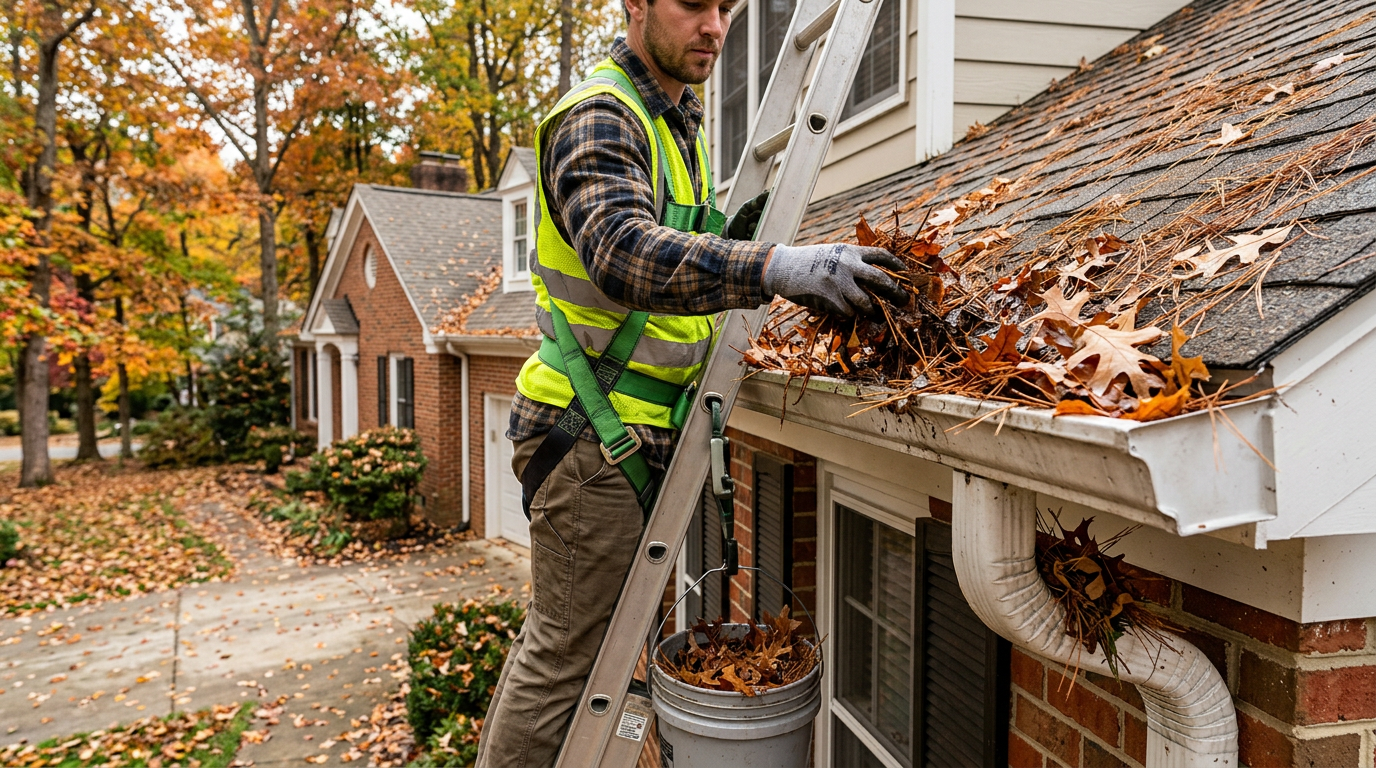
· Full debris removal, including the wet compacted layer at the bottom of the trough.
· Downspout flow testing at every outlet, confirmed at the discharge point, which is where moss and oak litter jam.
· Discharge direction, so storm volume travels away from the house rather than releasing at the foundation.
· Hanger and pitch check, because wet moss and debris are heavy and a sagging run holds standing water.
Why it is a rhythm and not a task
The oaks shed year round, the moss comes down with every wind, and the salt never stops arriving. A Savannah gutter is always loading, which means a system cleared in June is loaded again by October.
That is the argument for HomeSmiles 365: quarterly attention, downspouts tested every visit, the exterior handled alongside it, and the condition written down.
Your weekends are for pumpkin patches, football and family. HomeSmiles Savannah clears the leaves and debris so your gutters carry rainwater where it belongs. Keep your feet on the ground and your weekend open.
Book your gutter cleaning.