Fall Gutters and Downspouts in Greater Portland Maine
Winter is coming. Is your home ready? In Greater Portland that question has a hard deadline attached, which is what makes gutter work different here than almost anywhere else. In a mild climate, a clogged gutter in December is a nuisance that can wait until February. In Maine, a clogged gutter in December is a block of ice sitting on the edge of your roof for three months.
The window is short and it closes fast
Maine leaf drop is compressed. The maples and birches go in a few weeks, the oaks hold on and drop late, and then the weather turns. There is a narrow stretch between the last leaves coming down and the first sustained freeze, and that stretch is when gutter work has to happen.
Clear them too early and the oaks fill them back up. Clear them too late and the debris is already frozen in place. Late October into November is the whole window, and it is the reason this job gets missed so often in Greater Portland. By the time most people get to it, it is a cold weather job on a ladder, which is not a job anyone wants.
Why a loaded gutter is an ice problem, not a water problem
This is the part that makes Maine different.
A gutter holding wet leaf debris going into winter cannot drain. When melt water comes off the roof, whether from a warm afternoon or from heat escaping through the roof deck, it reaches the gutter and stops. Then it freezes. Then more water arrives on top of it and freezes too.
That ice does three things. It adds serious weight to a system hanging off a fascia board, which is how gutters pull loose and come down. It backs water up at the roof edge, where the roof was designed to shed water, not hold it against itself. And it works through repeated freeze and thaw cycles all winter, each one pushing that standing water a little further into whatever it is sitting against.
A clear gutter with a clear, tested downspout drains the melt. A loaded one holds it.
The downspout is where it fails
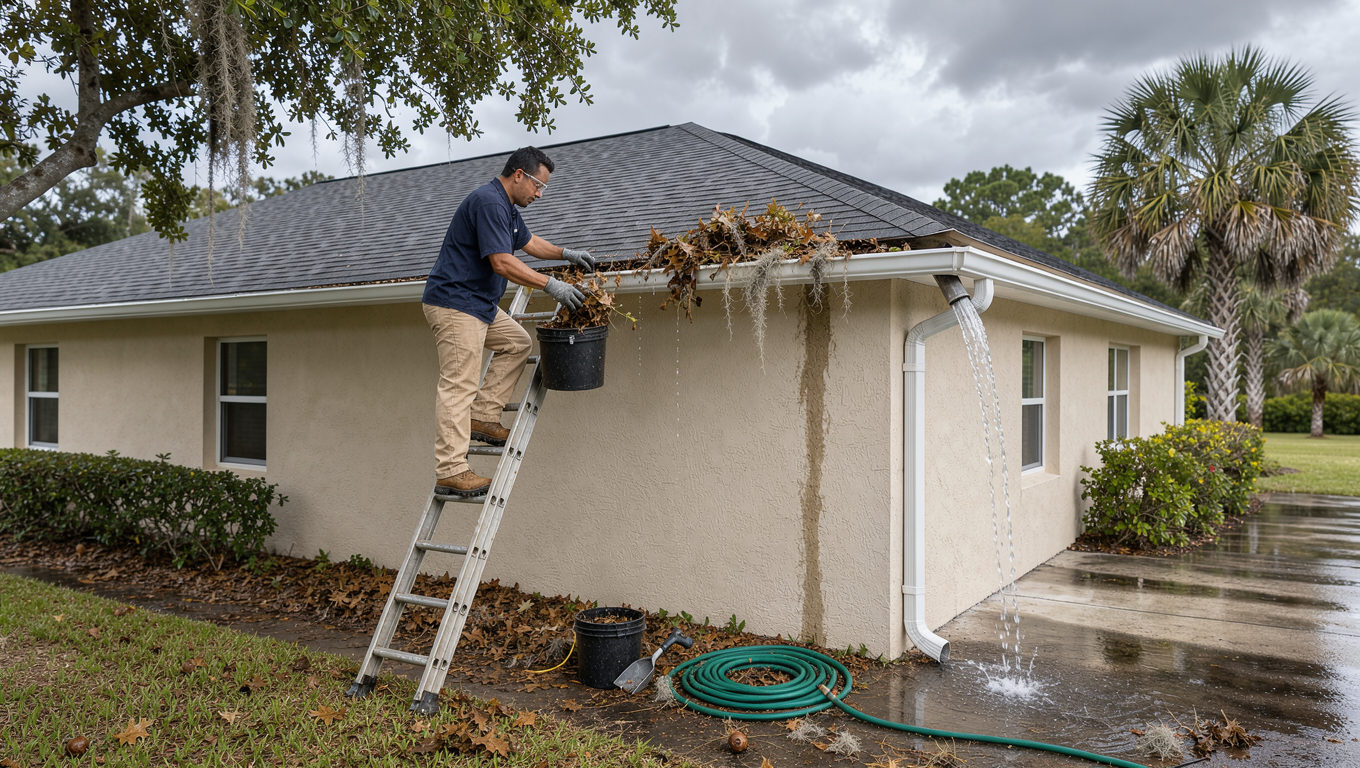
Debris travels to the outlet and jams at the first elbow, the narrowest point in the system. From the ground the trough looks clear, and it is. The water still has nowhere to go. In winter, that jam means the downspout itself freezes solid, and then nothing drains until spring no matter how clear the trough is.
Testing every outlet with water, and confirming it at the discharge point, is the single most important part of a fall clearing in this climate.
What a professional clearing covers
· Full debris removal, including the compacted layer at the bottom of the trough, which is what holds moisture and freezes first.
· Downspout flow testing at every outlet, confirmed at the discharge, so nothing goes into winter with a hidden jam.
· Discharge direction, so melt water travels away from the foundation rather than pooling at a corner and refreezing there.
· Hanger and pitch check, because a sagging run holds standing water, and standing water is where the ice starts.
Why it is seasonal and never finished
The leaves come down every fall and the oaks drop late every year. A house cleared in spring is fully loaded by November. There is no permanent version of this job, only a current one, and in Maine the current one has a deadline.
That is the case for HomeSmiles 365: the drainage system gets attention on a quarterly rhythm, downspouts tested on every visit, condition documented, with the fall visit timed to land inside the window rather than after it.
Your weekends are for pumpkin patches, football and family. HomeSmiles Greater Portland clears the leaves and debris so your gutters carry rainwater where it belongs. Keep your feet on the ground and your weekend open.
Book your gutter cleaning.